Using a slant board is one of the most effective ways to radically improve the health of your feet, ankles, and legs. Slant board exercises can be performed at home as part of home workouts, making them accessible for anyone looking to enhance their lower body strength, flexibility, and balance.
Whether it’s injury rehab, flexibility/mobility development, or full blown strength training, the slant board is a powerful tool for lower body strength, flexibility, and balance. It intensifies traditional workouts, deepens stretches, and helps improve overall mobility, which is essential for injury prevention and reversing the effects of prolonged sitting.
Today we’re going to take a look at some of the most effective exercises you can do on a slant board. These exercises can be easily integrated into your regular exercise routine or fitness regimen, supporting an active lifestyle and overall fitness. Incorporating slant board exercises helps promote a well-rounded fitness profile, improves joint health, and reduces the risk of overuse injuries. They are especially beneficial for the lower body, enhancing athletic performance and aiding in rehabilitation of lower-body injuries.
The benefits of doing these exercises regularly are simply insane. Take a step forward in your fitness journey by adding slant board exercises to your routine for comprehensive strength, flexibility, and injury prevention.
I’ve separated the exercises into static stretches, followed by ‘knees over toes’ exercises (or general strength exercises), and lastly some specific exercises for certain leg injuries.
Let’s begin!
5 Best Slant Board Stretches
Before starting your slant board exercises, it’s essential to include warm ups to increase blood flow and prepare your joints for stretching, supporting overall joint health. Slant boards promote better blood circulation and controlled joint loading, which is especially important for physical therapy and injury prevention in conditions like plantar fasciitis and Achilles tendonitis. After your stretching routine, don’t forget to include cool downs to prevent muscle stiffness and support recovery.
It is possibly the most effective way slant board stretch out the calves as well as the Achilles tendon and hamstrings.
For best results, hold each stretch for at least 90 seconds. I personally experienced huge flexibility gains from holding each stretch for 2 minutes. Always use proper form—keep your knees aligned with your toes, engage your core, and perform slow, deliberate movements to prevent injury. Stability and proper form are crucial to avoid lower back strain and knee injuries.
Let’s quickly take a look at some basic but extremely effective stretching exercises you can do on a slant board.
1. Slant Board Wall Calf Stretch
To perform the wall calf stretch, stand on the slant board with both feet while leaning up against a wall. Make sure to keep your heels down during the stretch to effectively target the deep calf and soleus muscle.
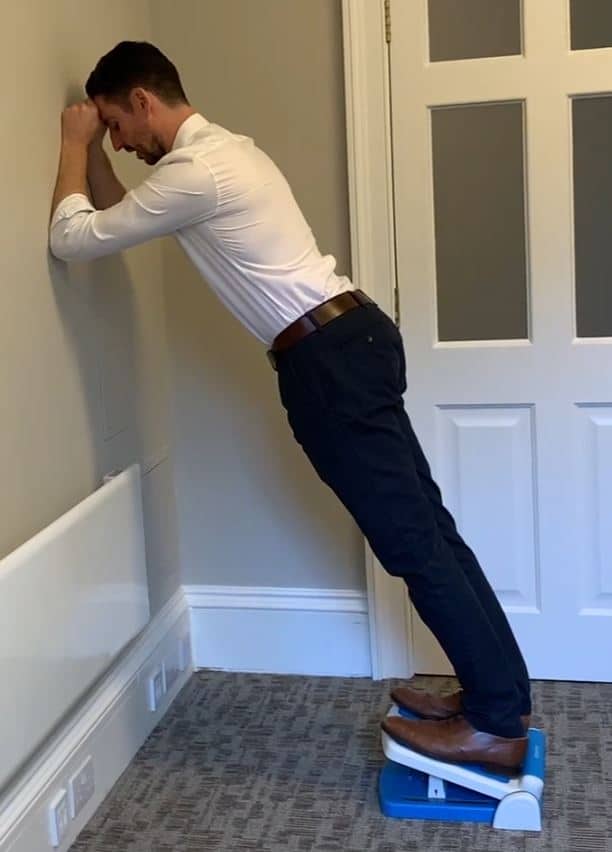
The angled surface of the slant board alleviates pressure on the Achilles tendon, allowing for increased ankle mobility. Slant boards are typically set at angles between 5° and 20°, which helps increase ankle range of motion and improve squat depth.
Hold the static position for at least 1.5-2 minutes. This stretch not only targets the calf muscles but also improves ankle stability and mobility.
You can increase the difficulty of this stretch by raising your incline slightly (if you’re using an adjustable slant board) or by performing the stretch on one leg as shown below.

If you don’t have an adjustable slant board, you can move the slant board further away from the wall which will force you to lean at a sharper angle to rest your upper body on the wall.
2. Slant Board Toe Touches
Toe touches are a great way to get a deep hamstring stretch in.
Begin in the starting position by standing with your toes elevated on the slant board, feet hip-width apart, and your legs straight (but not locked) to ensure proper form and flexibility. While keeping your lower back in a neutral position, bend over and reach down towards your toes. Using the slant board allows for a wider and greater range of motion compared to flat ground, helping to improve flexibility and muscle engagement. Hold the stretch at the bottom for a few seconds to maximize the benefit.
You can alter the difficulty of this stretch by standing partially or fully on the slant board and by increasing the incline. Jefferson curls on a slant board are another effective exercise that targets the hamstrings and enhances spinal mobility by rolling the spine down with light weight.
3. Slant Board Soleus Stretch
The single leg slant board soleus stretch (tongue twister?) is performed by starting in a full single leg calf stretch and then pushing your knee as far forward as you can while keeping the heel down. This stretch specifically targets the soleus muscle, which is crucial for improving ankle range and supporting knee health. By focusing on the soleus, you help enhance joint mobility and stability, reducing the risk of knee pain and supporting overall lower body function.
Find the point in the movement where the stretch is most intense and hold for 2 minutes.
The soleus stretch is also a great way of developing ankle mobility and Achilles tendon length. Additionally, performing heel elevated squats on a slant board can further improve ankle range and mobility. The incline of the slant board allows you to achieve deeper squat depths, even enabling a ‘butt-to-heels’ squat that may not be possible with limited mobility.
4. Slant Board Single Leg Pike Stretch
The single leg pike stretch is another excellent way to stretch the hamstrings.
With 1 foot on the slant board, bend forward and touch your toes while keeping a neutral spine.
Maintaining better form during this stretch helps maximize muscle engagement and improves lower body flexibility.
Be sure to maintain a slight knee bend (don’t lock your knee out).
5. Slant Board Jefferson Curl
Jefferson curls can be performed both as a stretch or as a strength exercise, specifically targeting the lower back, hamstrings, and enhancing spinal mobility.
The idea is to tuck your chin into your chest, flex your spine (i.e. bend your back), and roll your spine forward one vertebra at a time, using slow, controlled movement throughout the exercise.
By doing jefferson curls on a slant board, you can achieve a deeper stretch in your hamstrings (as well as calves) and further improve your range of motion and spinal health by rolling the spine down with light weight.
This is definitely one of the more advanced exercises, so proceed with caution!
7 Best Knees Over Toes Slant Board Exercises
If you’re looking for more of a hardcore slant board workout, there’s plenty of really excellent strength exercises you can do to develop really strong quads and hamstrings. These slant board exercises are key for improving knee stability by strengthening the surrounding muscles, such as the quadriceps and VMO, and promoting proper knee alignment during movement. Enhanced muscle engagement is achieved by focusing on controlled movements and proper form, which is essential for maximizing results and should be a core part of your regular fitness routine or fitness regimen.
Most of these exercises fall under the ‘knees over toes‘ training methodology which is geared towards increasing strength and mobility through developing your knee and ankle joints. Strengthening these muscles with slant board exercises not only helps prevent injury and knee pain, but also encourages safe knee travel. For best results, always use slow, controlled movements and adjust the incline of the slant board to match your individual mobility level.
Key slant board exercises include slant board squats, ATG split squats, calf raises, and tibialis raises. These target the quadriceps, hamstrings, and calves while also enhancing ankle mobility.
Let’s take a look at some of my favorites.
1. Slant Board VMO Squat/Cyclist Squat
The VMO or cyclist squat is a type of heel elevated squat performed on the slant board.
Begin in the proper starting position: stand with your feet shoulder-width apart on the slant board, ensuring your heels remain in contact with the board. Maintain proper form by keeping your chest up, back straight, and knees aligned with your toes throughout the movement.
Common mistakes to avoid include letting your knees collapse inward, lifting your heels off the board, or leaning excessively forward.
You can do these with just your bodyweight or you can use kettlebells, dumbbells, or even a barbell.
For more detailed instructions on this exercise and why it’s so effective, be sure to check out my full article on slant board squats!
2. Slant Board Patrick Step
The Patrick step is a simple single leg stepdown which can be performed on a slant board. As part of your routine, you can also include slant board calf raises, which are effective for targeting the calf muscles and improving ankle stability. These can be used as a warm-up or supplementary exercise to help prepare your ankles and calves for physical activity.
Make sure your knee moves out over your toe and keep your other leg straight for balance. Perform all movements slowly and with control to maximize injury prevention benefits.
If done correctly, you should feel a strong burn in your VMO. For additional injury prevention, consider adding tibialis raises to your routine, as they are effective in preventing injuries such as shin splints.
3. Slant Board Split Squat
The slant board split squat is a great way of increasing the knee/quad activation during the typical split squat movement. The ATG split squat, performed with a ‘knees-over-toes’ movement, increases range of motion, stretches the hip flexors, strengthens the quadriceps, and improves knee stability.
In a split stance, drive downward through your front knee using your rear leg only for stability. As you progress, you can work toward performing a deep squat on the slant board for even greater lower body strength and stability.
These exercises not only build muscle but also enhance athletic performance by improving functional strength and reducing the risk of injury in sports and physical activities.
Incline angle doesn’t matter too much here.
4. Slant Board Front Squat
Deep front squats are incredibly difficult without an elevated surface and some degree of lower back rounding is likely.
Some athletes use olympic lifting shoes to improve squat form and depth by increasing heel elevation and stability, but a slant board can provide similar benefits. The incline of a slant board allows users to achieve squat depths that may be impossible due to mobility restrictions, enabling a ‘butt-to-heels’ squat with a straighter spine.
This exercise is no different to the VMO/cyclist squat, only that we’re using a barbell for load.
5. Rear Foot Elevated Deadlift
Using a kettlebell or dumbbell, stand on the slant board with one foot and lower the weight to the ground while focusing on shooting your hips backward instead of bending at the knee.
This is a great unilateral glute exercise, and just one example of the various exercises you can perform on a slant board as part of a comprehensive fitness routine.
6. Slant Board Tibialis Raise
The decline platform is the hardest variation of the tibialis raise, an exercise that targets the tibialis anterior muscle and also engages the calf muscles.
Simply stand on the slant board and pull your toes up towards your knee using the muscles on your shins.
Tibialis raises help reduce shin splints and improve lower leg, knee, and ankle health.
The higher you stand on the slant board, the tougher the exercise will be.
Squeeze at the top briefly before lowering and repeating until your shins are on fire!
7. Slant Board RDL
The slant board can be used to increase the range of motion in a typical Romanian deadlift (RDL), making it an excellent exercise for improving lower body strength and flexibility.
As the hamstrings are engaged throughout the entire motion, the slant board will ease the load on your lower back and increase it on your hamstrings. Regular use of slant boards also helps prevent overuse injuries, such as Achilles tendinitis and calf strains, by enhancing joint stability and strengthening the tendons and muscles around the ankles and knees—often referred to as ‘bulletproofing’ the joints.
Be sure to take a look at my full list of knees over toes exercises.
3 Best Slant Board Exercises For Knee Pain
Depending on which specific type of knee pain you’re suffering from, you may like to choose different exercises. Slant board exercises can help alleviate knee pain by improving mobility, reducing muscle tightness, and addressing knee issues such as instability or discomfort caused by muscle imbalances. However, some movements, like elevated squats, may place additional stress on the knees and might not be suitable for individuals with pre-existing knee issues or arthritis.
Always ensure the slant board is stable before starting your workout to avoid injuries and prioritize personal safety by checking for features like sturdiness and non-slip surfaces.
I recommend having your knee pain diagnosed by a professional before doing any rehab exercises.
1. Slant Board Step Down
This is a modified/easier variation of the Patrick step, often called a heel elevated step down. This beginner-friendly slant board exercise helps strengthen the knees.
The only difference is this step down is slower and more controlled and you finish the movement on the ground before stepping off and starting again.
If this is too easy, consider switching to the Patrick step if you can do it without pain.
2. Slant Board Patrick Step
When you’re ready to progress from the above movement, start incorporating the concentric movement by transitioning into a full Patrick step. Make sure to keep your feet hip-width apart during the exercise, as this stance is important for both safety and effectiveness.
This is an effective way to develop the VMO while avoiding aggravating the knee.
Start with just the slant board to begin with and once that’s fairly easy, you can elevate the slant board on some weight plates to increase the range of motion.
3. Slant Board ATG Squats
ATG squats are a type of deep squat, similar to the VMO/cyclist squats we discussed earlier, that enhances knee stability and supports knee health.
These full depth squats are one of the best ways to develop squat strength through the full range of motion while strengthening the muscles around the knee for improved joint support.
Only perform these if you can do them without pain!
Best Slant Board Exercises For Plantar Fasciitis
As someone who’s gone through a bout of plantar fasciitis, I can completely understand how annoying life can be with this condition.
Slant board exercises are often used in physical therapy for plantar fasciitis recovery, as part of a structured approach to improve strength, flexibility, and balance. I was able to work through my fasciitis in a number of weeks, not months, and you might have similar results if you start regularly doing some of these exercises.
Slant Board Wall Calf Stretch For Plantar Fasciitis
The wall calf stretch is one of the best exercises you can do for plantar fasciitis with a slant board. Regular stretching like this can also help prevent calf strains, which are common overuse injuries, especially in runners and active individuals.
I discussed this exercise earlier but the key is to hold for quite a long time.
Aim for a couple sets of 2 minute holds, 3 times a day.
Scroll up to the first exercise in this article for more information on how you can make this stretch more difficult, or check out these best stretches to jump higher for more targeted tips.
Slant Board Calf Raise
Calf raises are one of the best ways to remedy plantar fasciitis, and doing them on a slant board is a great way to maximize range of motion and muscle engagement. When performing calf raises, focus on keeping your heels down at the start and then lifting them in a controlled manner to fully activate the calf muscles. Proper heel positioning and controlled movement help ensure effective muscle engagement and target the calf muscles for improved strength and flexibility.
You can hold onto the wall or a piece of furniture for support while performing this exercise.
Try to only do calf raises every 2-3 days to give the muscles a chance to recover.
3 Best Slant Board Exercises For Achilles Tendonitis
Achilles tendinopathy rehab can also be performed using a slant board. These exercises are effective for improving ankle range and ankle stability, which are important for preventing injury and enhancing lower body performance. For safety and effectiveness, start with a lower incline on the slant board and gradually increase it as your balance and strength improve. Below are some of the more popular exercises for this ailment.
1. Slant Board Soleus Stretch For Achilles Tendonitis
The soleus stretch is performed by standing on a slant board and pushing your knee as far forwards as possible while your heel stays on the ground. This stretch specifically targets the deep calf muscle, which is important for Achilles tendon recovery.
You should feel a strong tendon stretch down the back of your leg.
2. Up With 2, Down With 1
This is an advanced exercise I recommend doing under the supervision of a physical therapist.
It’s done by performing a normal bilateral calf raise on a slant board at around 25 degrees incline.
After reaching the top of the movement, hold the position for a few seconds to maximize muscle engagement, then come back down very slowly on the injured leg.
Physios recommend performing 50 reps 3 times per day, but warn that this is not an entry level exercise!
3. Slant Board Wall Calf Stretch For Achilles Tendonitis
One of the best ways to improve tendonitis is by simply lengthening the tendon and surrounding muscles. When performing slant board exercises like the wall calf stretch, it is crucial to use proper form—maintain a straight back, keep your chest up, and avoid locking your joints. Move slowly and with control throughout the stretch to prevent injury and maximize effectiveness.
Our standard slant board wall calf stretch is one of the best stretches for Achilles tendonitis.
Best Slant Board Exercises For Patella Tendonitis
As a former patella tendonitis sufferer, there are plenty of exercises I’ve already discussed in this article which will help improve the condition. Incorporating these slant board exercises into your regular fitness routine is essential, as they not only target the VMO but also support overall joint health. A structured approach to these exercises can promote joint mobility, reduce injury risk, and enhance the longevity of your joints during physical activity.
I’d recommend trying all of the knees over toes exercises to see which ones you can perform to strengthen your VMO without causing knee pain.
Here are a couple extra ideas I’ve not yet mentioned.
Slant Board Knee Circles
The idea of this exercise is to slowly bend your knees and draw a semicircle in the air with them, going back and forth. Controlled, gradual bending enhances safety and effectiveness during the movement.
This exercise should reveal any range of motion imbalances you may have in each leg.
Slant Board Wall Calf Stretch For Patella Tendonitis
I’ve already mentioned the slant board wall calf stretch several times, but it works great for patella tendonitis as well.
To begin, make sure you are in the correct starting position: stand on the slant board with your feet hip-width apart, heels down, and toes pointing forward. Keep your back straight and align your body so your shoulders, hips, and ankles are in a straight line. This alignment is important for both safety and effectiveness.
One extra variation you can try is to shoot your hips backwards and climb down the wall with your upper body.
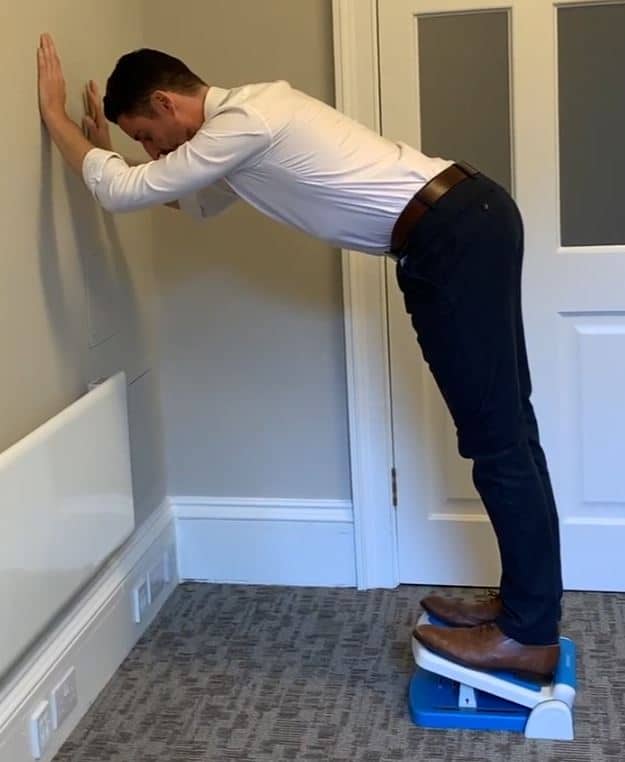
This will produce an epic stretch down the backs of your legs.
Best Slant Board Exercises For Ankle Mobility
Any of the aforementioned stretches will go a long way to developing ankle mobility and improving ankle range, allowing for a greater range of motion during your exercises. This enhanced range not only benefits your ankles but also contributes to overall lower body flexibility.
Similarly, any of the strength exercises which utilize that full ‘ass to grass’ range of motion will also tend to positively impact ankle mobility and help you achieve a greater range in your movements.
Here’s one extra exercise you can try.
Slant Board Ankle Drivers
The idea of the ankle drivers is to ‘pulse’ into a typical slant board calf stretch using your hips and knees, which helps improve ankle stability when performed with controlled movement.
You should start with your knee in line with your toes, but you can also try a variation where your knee pushes over your pinky toe or big toe – the idea is to pulsate that ankle joint from multiple angles.
How Long Should I Stand On A Slant Board?
If you’re looking to develop flexibility by using a slant board, you should hold the stretch for an absolute minimum of 90 seconds. However, even holding a stretch for a few seconds at the end range can be beneficial for muscle engagement, as brief, controlled holds help activate the muscles and prevent strain.
I prefer and have had better results holding each stretch for 2 minutes.
This gives the muscles plenty of time to relax and lengthen which will create a lasting effect on your flexibility.
Possibly the biggest mistake people make when using a slant board is not holding the stretch for long enough!
Which Slant Board To Use?
There’s tons of adjustable slant board on the market, many of which are a waste of money, and others that are really worthwhile. For personal safety, choose a slant board with non-slip surfaces and sturdy construction. Select a slant board made from durable materials to ensure stability and safety during use. Also, consider the size of the slant board based on your available storage space and the area where you will exercise.
Be sure to check out the following roundup article to get a good idea of which products make sense for you.

Share:
Facebook Twitter Youtube
More Posts
Why Every Home Gym Needs a Pulley Workout Machine

Best Pulley System for Home Gyms: Rogue cable machine vs. Shogun Flex
Top Cable Workout Machines: Exercises to Build Strength & Size

The Top Home Gym Pulley System for Versatile Workouts – 2025
Shogun Flex Review: A Comprehensive Look at the Ultimate Home Gym Pulley System

What is ATG and Knees Over Toes Training?

7 Best Supplements for Strength, Endurance, and Recovery
What is the Difference Between Strength Training and Conditioning?
What is the Best Recovery Method for Athletes?
Comprehensive Review of the Freak Athlete Hyper Pro
Top Infrared Sauna Blankets of 2025: Benefits, Reviews, and How to Choose the Best One for Your Wellness Routine
The Best ATG Online Coaching Program
Top 10 Benefits of Sauna and Cold Plunge Therapy

Best Cold Plunge Temperature: Essential Tips for Optimal Cold Therapy
IR vs Traditional Sauna: Which One Suits You Best?

2 Best Hip Thrust Belts Of 2025 (For Dumbbell Hip Thrusts)
Reverse Sled Pulls: The Ultimate Knees Over Toes Exercise

Best Weighted Vest: The Ultimate Review of the Wolf Tactical Weighted Vest and Plates
6 Best Shoes For Vertical Jump In 2025 (Jump Training & Dunking)

Rogue Plate Carrier Review: Is It the Best Plate Carrier for Your Workouts?
Send Us A Message
Name
Phone
Name
Phone Number
Message