Everyone knows the Nordic is one of the most effective hamstring exercises of all time.
The issue is it requires a bit of equipment (or a training partner) which people often don’t have access to.
Nordics can also be super difficult as a beginner and so it can be a good idea to start out with some easier exercises before you start working on Nordic regressions. Many bodyweight exercises can serve as effective Nordic curl alternatives for those without equipment, allowing you to strengthen your hamstrings and glutes at home or in the gym. Each bodyweight exercise is fundamental for hamstring and glute development without the need for equipment.
At the end of this article I’ve put together a list of 8 unique Nordic alternatives, most of which you probably haven’t seen before. The Romanian deadlift is highlighted as a great leg curl alternative, offering an effective way to target the hamstrings and glutes while improving functional strength.
These are my absolute favorite exercises when Nordics simply aren’t an option. They are also excellent leg curl substitutes for targeting the hamstrings without the need for machines.
Let’s begin!
These exercises not only help you build strong hamstrings, but also strengthen the entire posterior chain and leg muscles for better overall lower body strength and stability.
Introduction to Hamstring Curls
Hamstring curls, often referred to as leg curls, are a foundational exercise for building strength and stability in the back of your thighs. These movements specifically target the hamstring muscles, which include the biceps femoris, semitendinosus, and semimembranosus. Whether you’re using a leg curl machine at the gym or opting for bodyweight variations like stability ball hamstring curls or nordic hamstring curls, the goal is the same: to develop strong, resilient hamstrings that support knee flexion and hip extension. While traditional leg curls are a staple, there are plenty of curl alternatives—such as sliding leg curls and stability ball exercises—that can be performed with minimal equipment. These options are perfect for anyone looking to diversify their hamstring workouts and ensure balanced muscle development, especially if you don’t have access to a leg curl machine.
Understanding Hamstring Anatomy
To get the most out of your hamstring exercises, it’s important to understand how these muscles work. The hamstrings are a group of three muscles running along the back of your thigh, stretching from your hip down to your knee. The biceps femoris sits on the outside and is responsible for both knee flexion and rotating your leg outward. The semitendinosus and semimembranosus are located more toward the inside and help with knee flexion and hip extension. When you perform exercises like nordic curls or glute ham raises, you’re engaging all three muscles, which is essential for building strength, improving flexibility, and preventing muscle imbalances. Focusing on both knee flexion and hip extension in your workout routine ensures that your hamstring muscles, especially the biceps femoris, are fully activated and developed.
Benefits of Curl Alternatives
Incorporating curl alternatives into your training offers a range of benefits that go beyond what traditional leg curls provide. Many curl alternatives, such as barbell squats, single-leg deadlifts, and romanian deadlifts, engage not only the hamstrings but also the glutes, core, and other supporting muscles. The Romanian deadlift is a great compound exercise for targeting the hamstrings and glutes, emphasizing the hip hinge movement. This leads to greater muscle activation, improved functional strength, and enhanced athletic performance. It is important to maintain proper form during these exercises to prevent injury and maximize their effectiveness. By challenging your body in different ways, these exercises can also help reduce injury risk by promoting balanced development and stability throughout the lower body. Plus, curl alternatives can be easily adjusted to match your fitness level, making them a smart choice for anyone looking to progress safely and effectively.
Why The Nordic Is Irreplaceable
I really need you to understand that it’s in your best interest to figure out a way to make the Nordic work, as opposed to throwing it into the ‘too hard basket’.
This is one of the few exercises that works the hamstrings in the complete opposite manner to most leg curl exercises…
Standing/prone leg curls primarily work the hamstrings during the concentric movement, when you’re curling your ankles in towards your thighs.
The Nordic, on the other hand, gets progressively more difficult throughout the eccentric, as your legs are straightening out, creating some of the most epic knee flexion stimulus known to exercise science.
Regardless of what alternative you pick, you simply won’t get this level of lower hamstring activation, which is why you should figure out how you can include Nordics in your routine before looking for alternatives.
Affordable Nordic Hamstring Curl Options
Gone are the days where it would cost you $600+ to get your hands on a Nordic bench…
There are a couple of really exciting new Nordic benches that have just come onto the market that only cost around $200-$250, which is a much easier pill to swallow.
Check out my full list of the current best (and most affordable) Nordic benches of 2023!
If you’re still not looking to pay that much, there are some really affordable alternatives like Nordic straps and bars which are super effective ways of transforming regular weight benches into Nordic benches. Another way to increase resistance and progress with Nordic hamstring curls is by using a weighted vest, which can help make the exercise more challenging as you get stronger.
Be sure to check out my article discussing how to do Nordic curls at home for more information!
Nordic Hamstring Curls With Zero Equipment?
You can also do Nordics with virtually no equipment…
All you need is a partner to hold your ankles.
In my Nordic curls at home article I also make mention of a method where you can use a wall to get a similar stimulus. For some bodyweight hamstring exercises, like sliding leg curls, you’ll need a smooth floor or other low-friction surface to perform them safely and effectively.
If, however, you really aren’t feeling the Nordic, here are the absolute best alternatives…
Choosing the Right Alternative
With so many curl alternatives available, it’s important to pick the ones that best fit your goals and abilities. If your focus is on boosting athletic performance, dynamic movements like kettlebell swings are excellent for developing explosive power in the hamstrings and glutes. For those aiming to increase muscle mass and strength, more isolated exercises like glute ham raises can provide targeted muscle growth. Always consider your current fitness level, any previous injuries, and your overall workout routine when selecting a leg curl alternative. By choosing the right exercises, you’ll maximize your results and keep your training both effective and enjoyable.
Barbell Exercises for Hamstring Development
Barbell exercises are a powerhouse addition to any hamstring workout routine, offering a proven way to build strength and muscle mass in the posterior chain. The barbell deadlift, in particular, is a staple for targeting the hamstrings, glutes, and lower back all at once. To perform a barbell deadlift with proper form, begin in the starting position with your feet shoulder width apart and your toes pointing straight ahead or slightly outward. Grip the barbell with your hands at shoulder width, keeping your back flat and your core braced. As you lift the barbell, drive through your heels, push your hips forward, and maintain a straight line from your head to your hips. Lower the barbell back down with control, ensuring your back stays neutral throughout the movement. Incorporating barbell deadlifts into your training not only enhances hamstring muscle activation but also boosts overall athletic performance by increasing power, stability, and functional strength.
Resistance Band Exercises for Hamstrings
If you’re looking for a leg curl alternative that requires minimal equipment, resistance band exercises are a fantastic option. The resistance band leg curl is especially effective for isolating the hamstrings, particularly the biceps femoris. To get started, anchor a resistance band to a sturdy object and loop the other end around your ankle. Begin in the starting position with your leg extended, then curl your leg by bringing your heel toward your glutes, keeping your knee stationary. Slowly return to the starting position, maintaining consistent tension in the band throughout the movement. Resistance band leg curls are perfect for home workouts or when you’re traveling, as they help build muscle strength and endurance in the hamstrings without the need for bulky gym equipment. This simple yet effective exercise can easily be added to your routine to target the hamstrings and support overall leg development.
Injury Rehabilitation Considerations
When it comes to recovering from a hamstring injury, choosing the right exercises is crucial for safe and effective rehabilitation. Nordic curls and glute ham raises are excellent choices, as they work the hamstrings in a lengthened position and help restore strength and flexibility. For nordic curls, start by kneeling on a soft surface with your feet hip width apart and your ankles secured. From the starting position, keep your torso forward and your body straight as you slowly lower yourself toward the ground, then use your hamstrings and glutes to return to the upright position. Glute ham raises can be performed on a glute ham developer or similar setup, focusing on controlled movement and proper form. These exercises not only promote muscle growth and balance but also reduce injury risk by strengthening the hamstrings through their full range of motion. Always prioritize technique and listen to your body during rehab to ensure a safe return to full activity.
Enhancing Athletic Performance with Curl Alternatives
To take your athletic performance to the next level, incorporating curl alternatives like the single leg deadlift and hip thrust can make a significant difference. The single leg deadlift is a dynamic exercise that challenges your balance and targets the hamstrings, glutes, and lower back. Start in the standing position on one leg, keeping your core engaged and your back straight. Hinge at the hips, lowering the weight toward the floor while extending your other leg straight behind you, then return to the starting position with control. The hip thrust is another powerful move for building glute and hamstring strength—simply position your upper back on a bench, feet flat on the floor, and drive your hips upward, squeezing your glutes at the top. These curl alternatives not only improve muscle activation and strength but also enhance speed, power, and agility, making them essential for anyone looking to boost their athletic performance.
8 Best Nordic Hamstring Curl Alternatives
Each of these exercises were selected because of how similar they are to the Nordic. The Glute-Ham Raise (GHR) provides better mechanical leverage than a full Nordic curl due to its machine configuration, making it a strong alternative. The 45-Degree Hip Extension is also effective for targeting certain hamstring heads and may lead to faster growth compared to the Nordic curl.
Before starting these alternatives, we recommend performing leg swings as a dynamic warm-up to actively engage the hamstrings and improve hip mobility.
These are also great leg curl alternatives for those seeking variety in their hamstring training.
They really slam the hamstring in that full knee extension position, which is the key element of the Nordic we’re trying to preserve.
Many of these exercises utilize hip hinge movements, which are essential for effective hamstring and posterior chain training.
Big shout out to Athletes Authority and their KVLR hamstring series which has a number of excellent Nordic curl alternatives.
1. Harop Curl
This exercise can be done either on a Nordic bench or a GHD machine.
If using a GHD machine, start with your knees wedged into the front of the pad as shown below. Focus on maintaining proper body forms for alignment and stability throughout the movement.
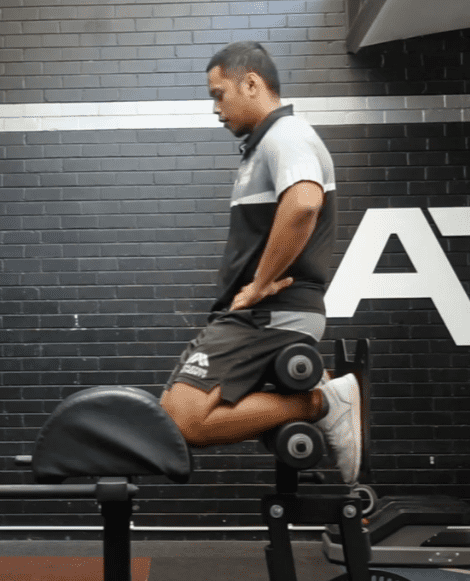
The cue for this exercise is to ensure your femur/thigh bone stays as vertical/perpendicular to the floor as possible.
Hinge at the hips by performing a controlled hip hinge movement, get your torso as low as you can, and curl back up.
It’s important to keep your body in a straight line from your head to your knees during the entire exercise to maximize effectiveness and safety.
2. Ring Leg Curl
This hamstring exercise can be done using TRX straps, gymnastics rings, or any sort of suspension straps.
Start with your hips up off the ground, keeping your body straight to maximize muscle activation and ensure proper form, and curl your legs in towards your body.
The higher you lift your hips up before beginning the motion, the harder the exercise will be.
If you’re super strong you can try the single leg variant.
Another advanced bodyweight exercise to consider is the single leg bridge, which effectively targets your hamstrings and glutes, and improves core stability without the need for complex equipment.
3. Suspended Hamstring Bodycurl
Using some suspension straps, or even a barbell, pull yourself up off the floor in a supine position with your feet straight out in front of you on a bench.
You can do these using both legs or with just a single leg and you can make it more difficult by adding a vest or backpack.
You can also just raise your hips higher in the starting position to make it tougher.
4. Modified Razor Curl
Using a normal setup for a Nordic, start this exercise by performing a hip hinge at the hips (keep your thighs vertical) and bending down to where you can reach a slider/ab roller. This movement involves significant hip flexion, which helps enhance strength and mobility in your hips and legs.
At this point you start hinging at the knees and extend your hands out in front of you until your body is fully elongated.
Then simply do the rep in reverse to get back to the starting position.
The hip hinge and flexion in the modified razor curl are similar to the good morning exercise, which primarily targets your hamstrings, glutes, and lower back muscles.
This one’s great for Nordics as it helps your hamstrings learn how to be under load for longer periods of time.
5. Razor Curl
The standard razor curl can be performed on a GHD machine.
Remember to start with your knees tucked into the front pad, keeping your knees bent to enhance the effectiveness of the exercise and better target the hamstrings, and we’re just hinging at the knees here. For a comprehensive list of all the knees over toes program exercises, check out this resource.
Your torso should remain parallel to the floor throughout the whole movement.
Once you reach that fully lengthened position, focus on exploding back into your starting position.
This one’s really good at helping you shift the focus from the upper hamstrings to the lower hamstrings, which is what happens when you switch from eccentric to concentric in the Nordic.
6. Single Leg Bosch Hold
The single leg Bosch hold is a super simple unilateral isometric exercise
Cross your arms around your chest, or you can cross your arms behind your neck to make the hold a little tougher.
7. Full GHR
The full glute ham raise is one of the best ways to train for a Nordic.
Again, make sure you’ve got your knees jammed into the front of the GHD pads to begin the movement.
Slowly lower yourself to parallel and then explode back upwards.
8. Seated Hamstring Curl
Although this movement isn’t much like the Nordic at all, it’s one of my absolute favorites for absolutely destroying the hamstrings while giving your glutes and lower back a rest. Seated leg curls are a popular machine-based variation for building hamstring strength. Both the seated leg curl and the lying leg curl are traditional machine-based exercises that target the hamstrings.
Using this machine is pretty self explanatory. The machine curl isolates the hamstrings but may not engage as many stabilizer muscles as compound movements. Just make sure you focus on being as slow as possible during the eccentric (on the way up) part of the movement.
Share:
Facebook Twitter Youtube
Tips for Effective Workouts
To get the best results from your hamstring workouts, proper form and technique are key—especially when performing exercises like leg curls, stability ball hamstring curls, or nordic hamstring curls. Start with a light weight or just your body weight to master the movement, and focus on slow, controlled reps to ensure you’re engaging the right muscles. Using a stability ball can add an extra challenge and help improve balance and coordination. Always warm up before you start and cool down after your session to reduce muscle soreness and lower your risk of injury. By maintaining proper form and gradually increasing the intensity, you’ll build stronger hamstrings and see improvements in your overall athletic performance. Incorporate a variety of curl alternatives into your workout routine to keep things fresh and target your muscles from different angles.